
Weather Elements and Social Crimes in Alimosho Local Government Area of Lagos State, Nigeria
-
Abiodun Daniel Olabode


Department of Geography and Planning Sciences, Adekunle Ajasin University, Akungba Akoko, Ondo State, Nigeria
Elisha Ademola AdelekeDepartment of Geography and Environmental Management, University of Ilorin, Ilorin, Nigeria
| Received 28 Oct, 2025 |
Accepted 02 Feb, 2026 |
Published 10 Feb, 2026 |
Background and Objective: Weather patterns can influence social behavior, including the occurrence of crimes. In Alimosho Local Government Area of Lagos State, crime rates remain a pressing social concern, yet the role of climatic elements in shaping criminal activities is not well understood. This study aimed to examine the effect of five weather elements on fifteen types of social crimes in the area. Materials and Methods: Secondary data on climate variables (temperature, rainfall, sunshine hours, cloud cover, and relative humidity) were obtained from the Nigeria Meteorological Agency (NiMet), while crime data were collected from the Nigerian Police Force, Lagos State Command. Data were analyzed using descriptive statistics (mean and coefficient of variation) and inferential techniques, including time series analysis, correlation, and regression analysis. Results: The analysis revealed a decreasing trends in cloud cover, relative humidity, and temperature, while rainfall and sunshine hours showed increasing trends. Theft was the most frequent crime (annual mean: 8,493 cases), and manslaughter the least (22 cases). Other high-incidence crimes included grievous harm (4,149) and assault (6,494). Trends indicated declines in store breaking, house breaking, burglary, armed robbery, kidnapping, rape, indecent assault, child stealing, assault, grievous harm, attempted suicide, and murder, whereas manslaughter, suicide, theft, and stealing were increasing under prevailing weather patterns. Temperature was positively correlated with most crimes, significantly with rape and indecent assault (r = 0.518). Regression analysis showed climate variables had the greatest effect on armed robbery (37%) and the least effect on assault (13%). Conclusion: Weather elements significantly influence crime patterns in Alimosho LGA. To mitigate these effects, the study recommends enhancing local security through vigilantes and private security groups to support the police, including the provision of necessary resources. Future studies could explore causal mechanisms linking specific weather patterns to criminal behavior.
| Copyright © 2026 Olabode and Adeleke. This is an open-access article distributed under the Creative Commons Attribution License, which permits unrestricted use, distribution, and reproduction in any medium, provided the original work is properly cited. |
INTRODUCTION
Crime affects everyone, regardless of ethnicity, religion, gender, or income level, it has become one of the major societal concerns and pressing issues facing all countries1. Particularly, the socioeconomic and quality of life have declined as a result of the high level of crime2. This is evident in a sharp rise in both the type and frequency of crimes in many parts of the world over the past 20 years, indicating a high crime rate worldwide3. Crime can occur anywhere in an urban area, but depending on its density and location, some areas will have a higher proportion of crime than others4. Urban crime activities are not consistently carried out throughout urban areas. In reality, it is said that the Central Business District (CBD) has greater crime rates because of its denser population, especially in commercial districts. Higher crime rates have been observed in areas such as city centers, huge market areas, regional retail centers, important transit hubs, and locations where drugs and alcohol are sold or used5. However, studies show that unemployment and poverty are the root causes of criminal behaviours2,3,5. Accordingly, the high rate of “unemployment and economic hardship which has pushed many jobless youths, some of whom are graduates, into various deadly crimes” has made Nigeria’s crime problem worse6. On the other hand, there is counterargument that criminal behavior is present in all kinds of people, including those who indulge in luxury7.
A large number of studies have evaluated the heat-aggression relationship statistically using State and national-level data. The U.S. annual national totals for assaults with the mean temperature from 1950 to 1999 were compared, along with annual state totals from 1960 to 19998. At both levels, assaults are significantly correlated with temperature. Our emotions can also be affected by temperature. According to research, when the temperature is around 72°F (22°C), we generally feel happier. We may become angry and irritable in exceedingly hot weather, and lethargic and unmotivated in extremely cold weather9. In a study in New Zealand, the weather variables consisted of temperature and precipitation, were found as evidence that supported violent crimes and property crimes that were caused by the weather variables10. The study also analyzed the relationship between property crime and weather. If the weather is ‘fine’ people are more likely to be absent from their homes, which gives the opportunity for theft and burglary to occur. Communities and individuals react to crime in Nigeria mostly from the perceived ineffectiveness (or otherwise) of the criminal justice system in combating crime and insecurity in their areas11.
In Nigeria, among the major causes of crime are a faulty system of education, erosion of traditional values, inadequate homes, poverty and unemployment, urbanization and industrialization and environmental influences12. However, little attention has been given researchers to relationship between crime and weather elements. This current study is focused on examining the impacts of temperature, relative humidity, rainfall, sunshine, and cloud cover on murder, manslaughter, attempted murder, suicide, attempted suicide, grievous harm wounding, assaults, child stealing, rape and indecent assault, kidnapping, armed robbery, theft, burglary, house breaking, and store breaking in Alimosho Local Government Area of Lagos State, one of the largest city in Nigeria. In order to achieve this aim, the objectives of the study include, description of weather elements and social crimes in the study area, examining the relationship between weather elements and crime, and determining the effects of weather elements on crime.
MATERIALS AND METHODS
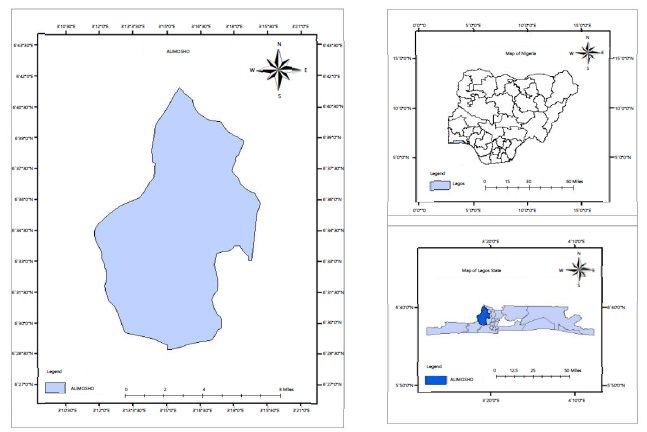
Study area: Nigeria, a tropical rainforest nation enjoys luxuriant quantity of sunshine, rainfall and humidity with variations from place to place, likewise the prevailing atmospheric conditions at different times across its 36 states. Alimosho Local Government Area is located in the Ikeja division of Lagos State, Southwest Nigeria and is the State’s largest local government area. Alimosho LGA consists of 6 Local Council Development Areas to increase efficiency in Administration and these include Agbado/Okeodo, Ayobo/Ipaja, Egbe/Idinmu, Mosan Okunola, Ikotun/Igando, and Egbeda/Akowonjo. The population of Alimosho is about 1,113,411 inhabitants with the majority being members of the Yoruba tribe. The commonly spoken languages in the area include Yoruba and English while Christianity and Islam are commonly practiced in the area. Popular landmarks in Alimosho LGA include the Alimosho General Hospital and the Alimosho Grammar School13. The Local Government Area has an average temperature of 26.5°C with humidity pegged at 80%. The two seasons witnessed in the area are the dry and the rainy seasons with total estimated precipitation of the area estimated at 2700 mm. The temperature range in Lagos is fairly small hence that of Alimosho is generally staying between a high of 91°F (33°C) and low at 70°F (21°C). The hottest month is March when average daytime temperature of 84°F (29°C) while July is the coldest month with an average temperature of 77°F (25°C). The best time to visit Lagos is during the cooler dry season, between August and September. The soils are majorly regosols with poorly established profiles below a thin surface humid area. The soils in some places are drained in excess and are susceptible to drought during the dry season. The dominant vegetation of Lagos State is the swamp forest consisting of the fresh water and mangrove swamp forest, both of which are influenced by the double rainfall pattern of the state which makes the environment a wetland region. Generally, the state has two climatic seasons: Dry (November-March) and Wet (April-October) (Fig. 1).
|
Type of data: Secondary data were used in this study, which include temperature, relative humidity, rainfall, sunshine, cloud cover, murder, manslaughter, attempted murder, suicide, attempted suicide, grievous harm wounding, assaults, child stealing, rape and indecent assault, kidnapping, armed robbery, theft, burglary, house breaking, and store breaking. The data covered the period of 20 years between 2001 and 2021.
Source of data: The climatic data were collected from the Nigerian Meteorological Agency (NiMET), Lagos State, NIMET. The agency with the sole responsibility of measuring, storing and controlling of meteorological data in Nigeria. The data on crime cases were from Research and Planning Department, Ikeja Nigerian Police Force, through the State Criminal Investigation Department Panti-Yaba, Lagos State.
Data analysis: Both descriptive (mean, standard deviation, and co-efficient of variation) and inferential (regression and correlation analysis) statistical methods were employed in this study. The coefficient of variation was employed to establish exiting variability among the climatic data; while relationship and significant impacts of both crime and climatic variables were determined with regression and correlation analysis.
Statistical software: The statistical software for the study is Statistical Package for Social Science (SPSS) version 20.
RESULTS AND DISCUSSION
Descriptive characteristics of weather elements and social crimes: Table 1 shows the descriptive characteristics of the weather elements. The result shows that the mean temperature in the area for the study period was 27.44°C with a standard deviation of 0.50 and a coefficient of variation of 1.82% implying that the temperature data was homogeneous. The observed condition of temperature shows that the study location has similar levels of heat tolerance, which is generally being controlled by both high or low temperature levels. The finding is in tandem with the recent study that high temperature has the potential to trigger irritability and impulsivity in individuals, which in turn increases aggressive behavior and leads to more violent crime13,14. The mean relative humidity recorded was 82.44% with a standard deviation of 1.74 and a coefficient of variation of 2.11% which implies that the relative humidity recorded was homogeneous. The mean rainfall recorded was 142.42 mm with a standard deviation of 17.78 and a coefficient of variation of 12.48 implying that the rainfall recorded in the area was homogeneous.
Table 1 shows that the mean sunshine hours recorded in the area was 5.26 hrs with a standard deviation of 0.24 and a coefficient of variation of 4.60%, which implies that the sunshine received was homogeneous. Furthermore, the mean cloud cover was 6.77 with a standard deviation of 0.31 and a coefficient of variation of 4.59%; this implies that the cloud cover recorded in the area during the period was homogeneous.
As shown in Table 2, the mean case of rape and indecent assault is 454 with a coefficient of variation of 51% indicating that the cases of rape and indecent assault are heterogeneous, meaning that the cases are not evenly spread across the entire local Government Area. The mean case of kidnapping recorded was 63 with a coefficient of variation of 90 which implies that the cases of kidnapping during the study period is heterogeneous. The mean incidence of armed robbery is 220 cases with a coefficient of variation of 99% indicating heterogeneity in the data set. The mean incidence of theft and other stealing was 8493 with a coefficient of variation of 43%; this implies that the cases during the study period is heterogeneous. The mean incidence of burglary is 869 with a coefficient of variation of 34% indicating the data is heterogeneous. The mean case of house breaking is 561 with a coefficient of variation of 40%; this implies that the cases of house breaking is heterogeneous. The mean incidence of store breaking 362 with a coefficient of variation of 38% indicating a heterogeneous data set. In agreement with the current study, Cohn and Rotton previous research equally analyzed theft, burglary and robbery in Minneapolis over two years using calls for service to measure criminal activity15.
| Table 1: | Descriptive characteristics of weather elements | |||
| Temperature | Relative humidity | Rainfall | Sunshine | Cloud cover | |
| Mean | 27.44 | 82.44 | 142.42 | 5.26 | 6.77 |
| STD | 0.5 | 1.74 | 17.78 | 0.24 | 0.31 |
| CV | 1.82 | 2.11 | 12.48 | 4.6 | 4.59 |
| Source: Authors' computation (2024) | |||||
| Table 2: | Descriptive characteristics of crime in the study area | |||
| Social crimes | Mean | STD | CV% |
| Murder | 225 | 88 | 39 |
| Manslaughter | 22 | 17 | 76 |
| Attempted murder | 68 | 110 | 161 |
| Suicide | 45 | 54 | 119 |
| Attempted suicide | 96 | 163 | 170 |
| Grievous harm wounding | 4149 | 1291 | 31 |
| Assaults | 6494 | 1927 | 30 |
| Child stealing | 130 | 120 | 92 |
| Rape and indecent assault | 454 | 234 | 51 |
| Kidnapping | 63 | 56 | 90 |
| Armed robbery | 220 | 218 | 99 |
| Theft and other stealing | 8493 | 3650 | 43 |
| Burglary | 869 | 291 | 34 |
| House breaking | 561 | 227 | 40 |
| Store breaking | 362 | 136 | 38 |
| Source: Authors’ computation (2024) | |||
| Table 3: | Relationship between weather elements and crime | |||
| Crimes/Weather | Temperature | Humidity | Rainfall | Sunshine | Cloud |
| Murder | 0.037 | -0.218 | -0.213 | 0.115 | 0.188 |
| Manslaughter | -0.281 | 0.075 | -0.098 | -0.197 | -0.332 |
| Attempted murder | 0.361 | -0.085 | -0.185 | 0.21 | 0.249 |
| Suicide | 0.312 | -0.037 | -0.14 | 0.001 | 0.062 |
| Attempted suicide | 0.273 | -0.13 | -0.234 | 0.172 | 0.261 |
| Grievous harm wounding | 0.193 | 0.066 | -0.325 | 0.16 | -0.015 |
| Assaults | 0.272 | -0.025 | -0.181 | -0.108 | -0.101 |
| Child stealing | 0.389 | 0.025 | 0.039 | -0.179 | 0.341 |
| Rape and indecent assault | 0.518* | 0.077 | -0.103 | -0.226 | 0.067 |
| Kidnapping | 0.395 | 0.281 | -0.256 | -0.174 | 0.143 |
| Armed robbery | 0.314 | 0.065 | -0.372 | -0.045 | -0.345 |
| Theft and other stealing | 0.055 | -0.151 | -0.092 | -0.304 | -0.009 |
| Burglary | 0.119 | 0.242 | -0.223 | -0.246 | -0.242 |
| House breaking | 0.36 | 0.05 | -0.301 | -0.017 | 0.005 |
| Store breaking | 0.398 | -0.032 | -0.17 | 0.009 | -0.047 |
| Source: Authors’ computation (2024) | |||||
Relationship between weather elements and crime: Table 3 presents the relationship between weather elements and crime in the area during the period under study. The result on murder and the elements of weather examined revealed that temperature (0.037), sunshine (0.115) and cloud cover (0.188) are directly related to murder case while humidity (-0.218) and rainfall (-0.213) are inversely related to cases of murder. The current findings agreed with the previous study, where the rates of violent crime are elevated during weeks with hot weather16.
The result showed that humidity (0.075) is directly related to manslaughter, while temperature (-0.281), rainfall (-0.098), sunshine (-0.197) and cloud cover (-0.332) are inversely related to the cases of manslaughter. The result for attempted murder showed that temperature (0.361), sunshine (0.21) and cloud cover (0.249) are directly related to attempted murder while humidity (-0.085) and rainfall (-0.185) are inversely related to attempted suicide. In the same vein, temperature (0.273), sunshine (0.172) and Cloud cover (0.261) is directly related to attempted suicide, while humidity (-0.13) and rainfall (-0.234) is inversely related to attempted suicide. Temperature (0.193), humidity (0.066) and sunshine hour are directly related to grievous harm wounding while rainfall (-0.325) and cloud cover (-0.015) are inversely related to grievous harm. The result for assault showed that Temperature (0.272) is directly related to assault while humidity (-0.025), rainfall (-0.181), sunshine (-0.108) and cloud cover (-0.101) are inversely related to assault. Furthermore, the result showed that temperature (0.389), humidity (0.025), rainfall (0.039) and cloud cover (0.134) is directly related to child stealing while sunshine (-0.179) is inversely related. In addition, literature has confirmed that the seasonality presented by robberies and rape offenses is associated with haze17, urban environments18, wind speed (WS), wind direction (WD), and relative humidity (RH)19.
Table 3 showed that temperature (*0.518) is significantly related to rape and indecent assault, humidity (0.077) and cloud (0.067) are directly related while rainfall (-0.103) and sunshine (-0.226) is inversely related to rape and indecent assault, Furthermore, temperature (0.395), humidity (0.281) and cloud cover (0.143) is directly related to kidnapping while rainfall (-0.256) and sunshine (-0.174) is inversely related. The result of armed robbery showed that temperature (0.314), humidity (0.065) is directly related to armed robbery while rainfall (-0.372), sunshine (-0.045) and cloud cover (-0.345) is inversely related to armed robbery. For instance20, demonstrates that there is a positive correlation between temperature and violent crimes (homicide, sex offense, self-harm, assault, etc.) by analyzing a dataset of crime incidents in England and Wales.
| Table 4: | Effect of weather elements on crime | |||
| Variables (Crimes) | R | R Square | Adjusted R Square | Std. error of the estimate |
| Murder | 0.423 | 0.179 | -0.095 | 92.25881 |
| Manslaughter | 0.56 | 0.314 | 0.085 | 15.95821 |
| Attempted murder | 0.59 | 0.348 | 0.13 | 102.51622 |
| Suicide | 0.373 | 0.139 | 0.148 | 57.50792 |
| Attempted suicide | 0.552 | 0.305 | 0.073 | 156.65925 |
| Grievous harm wounding | 0.434 | 0.188 | -0.083 | 1343.0301 |
| Assaults | 0.36 | 0.13 | -0.161 | 2076.3417 |
| Child stealing | 0.594 | 0.352 | 0.137 | 111.2316 |
| Rape and indecent assault | 0.589 | 0.347 | 0.129 | 199.12943 |
| Kidnapping | 0.583 | 0.34 | 0.12 | 52.82894 |
| Armed robbery | 0.608 | 0.37 | 0.16 | 200.12898 |
| Theft and other stealing | 0.386 | 0.149 | -0.135 | 2852.201 |
| Burglary | 0.485 | 0.235 | -0.019 | 294.00744 |
| House breaking | 0.487 | 0.237 | -0.017 | 228.63485 |
| Store breaking | 0.447 | 0.2 | -0.067 | 140.3331 |
| Source: Authors’ computation (2024) | ||||
In Table 3, temperature (0.055) is directly related to theft and other stealing while humidity (-0.151), rainfall (-0.092), sunshine (-0.304) and cloud cover (-0.009) is inversely related to theft and other stealing. Furthermore, temperature (0.119) and humidity (0.242) is directly related to burglary while rainfall (-0.223), sunshine (-0.246) and cloud cover (-0.242) is inversely related to burglary. The result temperature (0.36), humidity (0.052) and cloud cover (0.005) is directly related to house breaking while rainfall (-0.301) and sunshine (-0.017) is inversely related to house breaking. Furthermore, temperature (0.398) and sunshine (0.009) is directly related to store breaking while humidity (-0.032), rainfall (-0.032) and cloud cover (-0.047) is inversely related to store breaking. In support of the current study, this current study agreed with other authors that sunny days were associated with increases in murder and hit-and-run deaths in Tokyo, Japan; and monthly temperatures positively correlate with murder and attempted murders across several cities in Pakistan21-23.
Effects of weather elements on crime: Table 4 shows the effect of weather elements on crime in the area. The result murder (0.179) showed that 17.9% of the incidences of murder can be accounted for by the examined weather elements while 82.1% of the cases of murder are accounted for by other elements such as poverty, emotionally imbalances among others. Manslaughter (0.314) was accounted for 31.4% of the cases by the examined weather elements, while 68.6% of the cases of manslaughter are accounted for by other elements. Furthermore, the result attempted suicide (0.48) shows that 34.8% of the cases of attempted suicide is explained by the weather elements, while 65.2% is accounted for by other factors. The result of suicide (0.139) shows that 13.9% of the suicide cases is explained by the weather elements while 86.1% is accounted for by other factors such as frustration, poverty and stress among others.
The attempted suicide (0.305) showed that 30.5% of the incidences of attempted suicide is accounted for by the examined weather elements, while 69.5% is as a result of other factors. The result grievous harm wounding (0.188) shows that 18.8% of the cases of grievous harm can be explained by the model while 81.2% of the cases of grievous harm wounding is as a result of other factors. The result of the assault (0.130) shows that 13% of the cases of assault can be explained by the weather elements by 87% of the cases are as a result of other factors. Furthermore, the result child stealing (0.352) shows that 35.2% of the cases of child stealing can be explained by the examined weather elements while 64.8% of the cases are as a result of other factors. Furthermore, the result rape and indecent assault (0.347) shows that 34.7% of the cases of rape and indecent assault can be explained by the examined weather elements while 65.3% of the cases is as a result of other factors. On the current findings, researchers have equally concluded that as the temperature increases, the number of assaults generally go up as well24-28.
Moreover, kidnapping (0.340) shows that 34% of the cases of kidnapping can be explained by the examined weather elements while 66% of the cases is as a result of other factors. Furthermore, the result of armed robbery (0.370) showed that 37% of the cases of armed robbery can be explained by the examined elements, while 63% of the cases are as a result of other elements. Furthermore, the result theft and other stealing (0.149) shows that 14.9% of the cases of theft and other stealing can be explained by the examined weather elements while 85.1% of the cases is as a result of other factors. The result burglary (0.235) shows that 23.5% of cases of burglary can be explained by the examined weather elements while 76.5% of the cases can be explained by other factors. Further, the result house breaking (0.237) shows that 23.7% of cases can be explained by the examined weather elements while 76.3% of the incidences of house breaking can be explained by other factors. Furthermore, the result store breaking (0.200) shows that 20% of the incidences of store breaking can be explained by the examined weather elements while 80% of the cases is a result of other factors such as hunger, poverty among others. These findings agree with a study that revealed a positive relationship between higher temperatures and property crime23.
CONCLUSION
The study concluded that weather elements has an effect on crime rate in the study area with the most significant effect on armed robbery, rape and indecent assault. The cases of social crimes are directly related to weather impact as explained by homogeneous behaviour of these social crimes to weather elements. On the other hand, some factors could as well influence social crime but majority if the crime committed in the study area were linked one way or the other to weather effect. The perpetrators of these heinous crime always take the advantage of favourable weather conditions to engage themselves in the crime. Decrease in crime at times was attributed to the increase in security the people put in place in order to secure their areas and an increase in employment status of the people also checked the rate of social crimes. The study therefore recommended that the community should employ vigilantes and private security guards around their business environments and residential areas to reduce the cases of store and house breaking. The government should also create more jobs by formulating policies that would create employment to reduce the cases of theft in the area.
SIGNIFICANCE STATEMENT
Weather elements are critical factors in determining crime related issues in the society. Types and rate of crimes could escalate when the critical weather elements that influence human behaviour are prominent in certain environment. Seasonal, this study revealed that increased temperature and some other weather elements can produce harsh weather and that will in turn lead to aggressive behaviour of criminal tendencies.
REFERENCES
- Ghani, Z.A., 2017. A comparative study of urban crime between Malaysia and Nigeria. J. Urban Manage., 6: 19-29.
- Badiora, A.I., A.O. Afon and O.T. Dada, 2017. Seasonality of violent and property crime in Nigeria: Some preliminary findings. Int. J. Criminol. Sociological Theory, 10.
- Usman, U., M. Yakubu and A.Z. Bello, 2012. An investigation on the rate of crime in Sokoto State using principal component analysis. Niger. J. Basic Appl. Sci., 20: 152-160.
- Oyinloye, M.A., S.A.A. Adegboyega, F.O. Akinluyi, A.A. Komolafe, J.O. Akinyede, O.O. Aladejana and S.O. Akande, 2023. Detection and mapping of violent crime hotspots in Southwestern Nigeria. J. Geogr. Inf. Syst., 15: 334-365.
- Jo, H., H. Ikei, C. Song and Y. Miyazaki, 2020. Individual differences in the psychological effects of forest sounds based on type A and type B behavior patterns. Urban For. Urban Greening, 55.
- Arokoyo, J.E. and E. Yunusa, 2025. Unemployment and crime in Nigeria: A review of the relationship between precarious employment and criminal behaviour. UAR J. Multidiscip. Stud., 1.
- Soh, M.B.C., 2012. Crime and urbanization: Revisited Malaysian case. Procedia Social Behav. Sci., 42: 291-299.
- Rotton, J. and E.G. Cohn, 2003. Global warming and U.S. crime rates: An application of routine activity theory. Environ. Behav., 35: 802-825.
- Ohaegbulem, E.U., 2015. A reliability assessment of the age-sex data from 1991 and 2006 Nigeria population censuses. Int. J. Adv. Stat. Probab., 3: 132-137.
- Horrocks, J. and A.K. Menclova, 2011. The effects of weather on crime. N. Z. Econ. Pap., 45: 231-254.
- Rotton, J. and E.G. Cohn, 2018. Temperature, routine activities, and domestic violence: A reanalysis. Violence Victims, 16: 203-215.
- Cohn, E.G., J. Rotton, A.G. Peterson and D.B. Tarr, 2004. Temperature, city size, and the Southern subculture of violence: Support for social escape/avoidance (SEA) theory. J. Appl. Social Psychol., 34: 1652-1674.
- Obono, O. and E. Omoluabi, 2014. Technical and political aspects of the 2006 Nigerian population and housing census. Afr. Popul. Stud., 27: 249-262.
- Rotton, J. and E.G. Cohn, 2000. Violence is a curvilinear function of temperature in Dallas: A replication. J. Personality Social Psychol., 78: 1074-1081.
- Thomas, C., J. Jeong and K.T. Wolff, 2025. Testing routine activity theory: Behavioural pathways linking temperature to crime. Br. J. Criminol., 65: 859-877.
- Jacob, B.A. and L. Lefgren, 2003. Are idle hands the devil’s workshop? Incapacitation, concentration, and juvenile crime. Am. Econ. Rev., 93: 1560-1577.
- Mares, D.M. and K.W. Moffett, 2016. Climate change and interpersonal violence: A “global” estimate and regional inequities. Clim. Change, 135: 297-310.
- Kim, S. and S. Lee, 2023. Nonlinear relationships and interaction effects of an urban environment on crime incidence: Application of urban big data and an interpretable machine learning method. Sustainable Cities Soc., 91.
- Shen, B., X. Hu and H. Wu, 2020. Impacts of climate variations on crime rates in Beijing, China. Sci. Total Environ., 725.
- Field, S., 1992. The effect of temperature on crime. Br. J. Criminol., 32: 340-351.
- Simister, J. and E. van de Vliert, 2005. Is there more violence in very hot weather? Tests over time in Pakistan, and across countries worldwide. Pak. J. Meteorol., 2: 51-66.
- Cohn, E.G. and J. Rotton, 1997. Assault as a function of time and temperature: A moderator-variable time-series analysis. J. Personality Social Psychol., 72: 1322-1334.
- Ikegaya, H. and H. Suganami, 2008. Correlation between climate and crime in Eastern Tokyo. Can. J. Criminol. Crim. Justice, 50: 225-238.
- Anderson, C.A. and D.C. Anderson, 1984. Ambient temperature and violent crime: Tests of the linear and curvilinear hypotheses. J. Personality Social Psychol., 46: 91-97.
- Harries, K.D., S.J. Stadler and R.T. Zdorkowski, 1984. Seasonality and assault: Explorations in inter-neighborhood variation, Dallas 1980. Ann. Assoc. Am. Geogr., 74: 590-604.
- Harries, K.D. and S.J. Stadler, 1988. Heat and violence: New findings from Dallas field data, 1980-1981. J. Appl. Social Pyschol., 18: 129-138.
- Perry, J.D. and M.E. Simpson, 1987. Violent crimes in a city: Environmental determinants. Environ. Behav., 19: 77-90.
- Anderson, C.A., B.J. Bushman and R.W. Groom, 1997. Hot years and serious and deadly assault: Empirical tests of the heat hypothesis. J. Personality Social Psychol., 73: 1213-1223.
How to Cite this paper?
APA-7 Style
Olabode,
A.D., Adeleke,
E.A. (2026). Weather Elements and Social Crimes in Alimosho Local Government Area of Lagos State, Nigeria. Trends in Social Sciences, 2(1), 6-13. https://doi.org/10.21124/tss.2026.06.13
ACS Style
Olabode,
A.D.; Adeleke,
E.A. Weather Elements and Social Crimes in Alimosho Local Government Area of Lagos State, Nigeria. Trends Social Sci 2026, 2, 6-13. https://doi.org/10.21124/tss.2026.06.13
AMA Style
Olabode
AD, Adeleke
EA. Weather Elements and Social Crimes in Alimosho Local Government Area of Lagos State, Nigeria. Trends in Social Sciences. 2026; 2(1): 6-13. https://doi.org/10.21124/tss.2026.06.13
Chicago/Turabian Style
Olabode, Abiodun, Daniel, and Elisha Ademola Adeleke.
2026. "Weather Elements and Social Crimes in Alimosho Local Government Area of Lagos State, Nigeria" Trends in Social Sciences 2, no. 1: 6-13. https://doi.org/10.21124/tss.2026.06.13

This work is licensed under a Creative Commons Attribution 4.0 International License.