
Beyond Conventional Agrivoltaics: Agroecological and Economic Pathways for Bifacial Solar-Agriculture Integration in Nigeria
-
Anyene Chinedu Chukwuemeka Christian


Federal Polytechnic, Oko, Nigeria
Ogochukwu Blessing AnyeneSaint Lawrence Anglican Church, Ndiowu, Nigeria
Ogbuagu Nneka JulianaNnamdi Azikiwe University, Awka, Nigeria
| Received 06 Aug, 2026 |
Accepted 20 Sep, 2026 |
Published 29 Sep, 2026 |
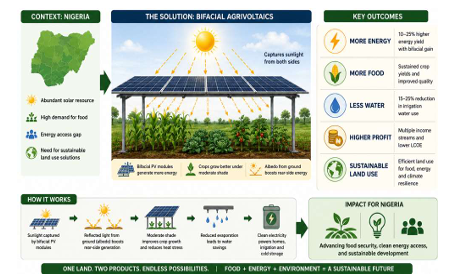
Background and Objective: Bifacial agrivoltaic (AV) systems have emerged as an innovative approach for simultaneously addressing food insecurity, energy shortages, and sustainable land management by integrating photovoltaic (PV) electricity generation with agricultural production. This systematic review evaluates the land-use efficiency and economic viability of bifacial agrivoltaic systems in Nigeria, examining how the country’s diverse agroecological conditions influence technical and economic performance. Materials and Methods: A systematic review of peer-reviewed literature published between 2013 and 2026 was conducted using established academic databases and relevant policy reports, following PRISMA guidelines. Results: Spatial variations in Nigeria’s agroecological conditions significantly affect the performance of bifacial agrivoltaic systems. The semi-arid Northern Regions exhibit the highest potential due to high solar irradiance (5.0-5.5 kWh/m2/day), reflective sandy soils, and increasing water scarcity, resulting in projected bifacial energy gains of 18-25% and substantial irrigation savings. The Middle Belt offers moderate opportunities through diversified cropping systems, while the humid southern regions demonstrate lower energy gains but considerable benefits from improved crop quality, reduced post-harvest losses, and solar-powered cold storage for high-value horticulture. Despite higher initial capital costs, bifacial agrivoltaic systems provide enhanced land-use efficiency, diversified farm income, and improved long-term economic returns compared with conventional monofacial systems. Conclusion: The review concludes that targeted policies, pilot-scale demonstrations, innovative financing mechanisms, and locally adapted system designs are essential to accelerate the deployment of bifacial agrivoltaics and strengthen Nigeria’s food-energy-water nexus while advancing national sustainable development objectives.
| Copyright © 2026 Christian et al. This is an open-access article distributed under the Creative Commons Attribution License, which permits unrestricted use, distribution, and reproduction in any medium, provided the original work is properly cited. |
GRAPHICAL ABSTRACT
 |
INTRODUCTION
Nigeria faces a critical and intensifying land-use conflict that lies at the intersection of food security, energy access, and environmental sustainability. With a population exceeding 200 million and projected to double by 2050, the demand for agricultural land to produce food competes directly with the spatial requirements for energy infrastructure development, particularly solar photovoltaic systems that require significant land area for utility-scale deployment1,2. This competition is exacerbated by urbanization, land degradation, and climate change impacts that reduce available productive land while simultaneously increasing demand for both food and energy.
The agricultural sector, which employs approximately 35% of Nigeria’s workforce and contributes about 25% to Gross Domestic Product, is the primary land user, with crop production occupying an estimated 34 million hectares3,4. However, agricultural productivity remains low by international standards, constrained by inadequate infrastructure, limited irrigation, and climate vulnerability. Simultaneously, Nigeria’s energy sector requires expanding land areas for renewable energy infrastructure to address the electricity access gap affecting millions of her citizens5. The country has committed to renewable energy targets under its Nationally Determined Contributions and Energy Transition Plan, but achieving these goals requires careful land-use planning to avoid competition with food production.
Agrivoltaics, also known as agriphotovoltaics or APV, presents a compelling solution to land-use competition by enabling simultaneous agricultural production and solar energy generation on the same land area6,7. The fundamental premise of agrivoltaics is to optimize the synergistic co-production of food and energy, thereby increasing land productivity and farmer resilience. This dual-use approach is particularly relevant for Nigeria, where land is a scarce and contested resource, and where rural communities need both improved agricultural productivity and access to electricity.
The land-use efficiency of agrivoltaic systems is measured by the Land Equivalent Ratio (LER), which compares the combined output of the dual-use system to separate monoculture agriculture and solar energy production on the same total land area8. An LER exceeding 1.0 indicates that the agrivoltaic system produces more combined value per hectare than separate land uses, demonstrating land-saving benefits. Recent studies have reported LER values for agrivoltaic systems ranging from 1.27 to 1.93, with bifacial systems generally achieving higher values than monofacial alternatives9,10.
Bifacial photovoltaic systems, which capture irradiance on both front and rear surfaces, offer distinct advantages for land-use efficiency in agrivoltaic applications. The elevated mounting heights required for agricultural machinery access (>2 meters) naturally optimize rear-side irradiance capture, creating synergistic benefits that monofacial systems cannot achieve11. The improved light uniformity beneath bifacial arrays, resulting from semi-transparent glass-glass construction and diffuse light transmission, enhances crop productivity while maintaining high energy output12.
The economic viability of bifacial agrivoltaics in Nigeria hinges on several key factors: The additional energy yield compared to monofacial systems (typically 14-20%); the capital cost premium (5-15%); agricultural benefits including irrigation savings, reduced heat stress, and improved crop quality; and the value of land-use efficiency gains13. Understanding the underlying economic drivers is fundamental to informed investment decisions and the development of appropriate policy frameworks.
This systematic review addresses the critical gap in evidence synthesis on land-use efficiency and economic viability of bifacial agrivoltaic systems in the Nigerian context. While international studies have demonstrated the technical potential of agrivoltaics, site-specific economic analysis accounting for Nigeria’s diverse agricultural systems, climatic conditions, and market realities remains limited. This review aims to provide a comprehensive evidence base to inform investment decisions, policy development, and research priorities.
Specifically, this review addresses four key questions: (i) What is the land-use efficiency of bifacial agrivoltaic systems as measured by Land Equivalent Ratio, and how does this compare to monofacial alternatives? (ii) What is the economic viability of bifacial agrivoltaics in different Nigerian contexts, considering energy yields, capital costs, and agricultural benefits? (iii) What factors influence the economic performance of bifacial agrivoltaic systems? (iv) What are the critical implementation pathways and policy interventions needed to scale bifacial agrivoltaics in Nigeria?
MATERIALS AND METHODS
Systematic literature review and search strategy: This study employed a systematic literature review in accordance with the PRISMA 2020 framework to assess the land-use efficiency and economic viability of bifacial agrivoltaic (APV) systems, with particular emphasis on their applicability to Nigeria. Literature published from January 2013 through January 2026 was searched in Scopus, Web of Science, ScienceDirect, and Google Scholar, with the search conducted on 15 March 2026. The search strategy combined terms relating to agrivoltaics, bifacial photovoltaics, land-use and agricultural performance, economic viability, and geographical context. The principal Scopus search string was:
TITLE-ABS-KEY((“agrivoltaic” OR “agriphotovoltaic*” OR “APV” OR “solar agriculture”) AND (“bifacial photovoltaic*” OR “bifacial PV” OR “bifacial solar”) AND (“land equivalent ratio” OR “LER” OR “land-use efficiency” OR “crop yield” OR “energy yield” OR “economic viability” OR “techno-economic” OR “LCOE”) AND (“Nigeria” OR “Nigerian” OR “Africa” OR “Sub-Saharan Africa”)) AND PUBYEAR>2012 AND PUBYEAR 2026.*
Equivalent database-specific syntax was applied to Web of Science, ScienceDirect, and Google Scholar.
Eligibility and study selection: Studies were included when they were published in English between 2013 and 2026 and reported relevant technical, agricultural, land-use, environmental, or economic outcomes associated with agrivoltaic or bifacial photovoltaic systems. Peer-reviewed articles, relevant conference papers, systematic reviews, theses, and authoritative technical reports were considered. Studies were excluded when they were duplicates, editorials, promotional or news materials, unrelated to APV/bifacial PV, focused exclusively on conventional rooftop or building-integrated PV, or lacked sufficient methodological or quantitative information.
|
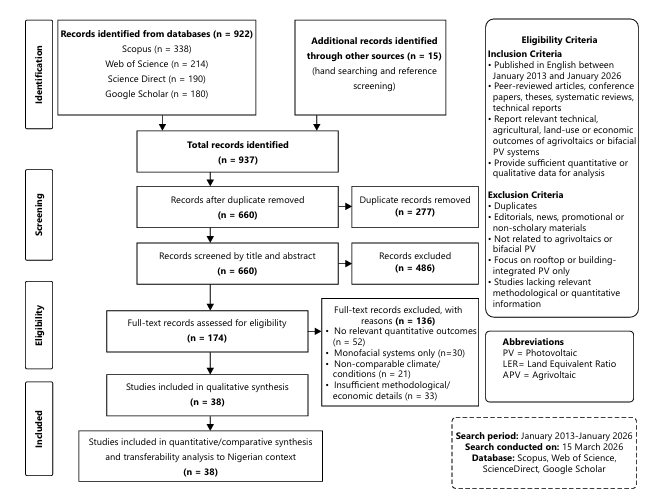
The search identified 937 records, comprising 338 from Scopus, 214 from Web of Science, 190 from ScienceDirect, and 180 from Google Scholar and 15 additional records identified through hand searching and reference screening. After removal of 277 duplicates, 660 records remained for title and abstract screening. Following screening, 174 records underwent full-text assessment, of which 38 studies satisfied the eligibility criteria and were included in the final synthesis. Reasons for exclusion were documented during full-text assessment. The complete selection process is presented in Fig. 1.
Quality assessment and data synthesis: The methodological quality of the included studies was assessed using a modified version of the Critical Appraisal Skills Programme (CASP) checklist for systematic reviews. Each study was scored against six criteria: (i) Clarity of research objectives, (ii) Appropriateness of methodology, (iii) Data adequacy and reliability, (iv) Transparency of system configuration, (v) Analytical appropriateness, and (vi) Reproducibility. Studies were rated as high (≥5/6), moderate (3-4/6), or low (≤2/6) quality. Low-quality studies were excluded from the final synthesis. Data were systematically extracted on study location and characteristics, PV configuration, bifacial gain, LER, ennergy yield, crop productivity, irrigation effects, CAPEX, OPEX, LCOE, and relevant climatic and agricultural conditions. Findings were synthesized using quantitative comparison and narrative/thematic synthesis. Where comparable data were available, ranges and comparative values were reported.
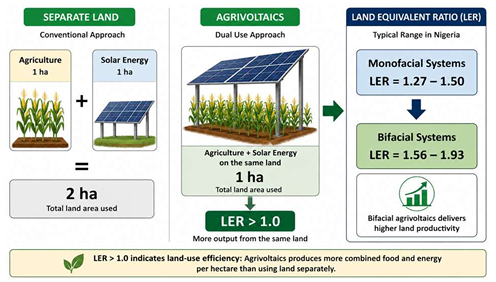
Transferability to Nigerian conditions: Because Nigerian-specific evidence remains limited, findings from other regions were assessed for transferability using the framework of Randle-Boggis et al.14. Transferability was evaluated according to climatic similarity (solar irradiance, temperature, and rainfall), Conventional agriculture and standalone photovoltaic systems require separate land areas (2 ha) to produce food and electricity, whereas agrivoltaics co-produces both outputs on the same hectare (1 ha), resulting in LER values greater than 1.0 agricultural similarity (crop type, farming practices, irrigation, and shading response), PV-system similarity (bifacial configuration, mounting characteristics, and albedo), and economic similarity (CAPEX, OPEX, electricity prices, and agricultural values). Evidence was subsequently classified as direct Nigerian evidence, transferable regional evidence, or general technological evidence, thereby minimizing inappropriate extrapolation from substantially different conditions.
|
Land-use efficiency: concepts and measurement
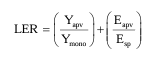
Definition and application of land equivalent ratio: The Land Equivalent Ratio (LER) serves as the ultimate integrative metric for dual-use agrivoltaic systems, quantifying the land-use advantage of combining agriculture and solar energy production on the same land area. LER is calculated as:
 |
(1) |
where, Yapv = Crop yield under the agrivoltaic (APV) system, Ymono = Crop yield under conventional open-field (monoculture) conditions, Eapv = Energy produced by the agrivoltaic system, and Esp = Energy produced by a standard solar plant on the same land area8,9.
An LER>1 indicates that agrivoltaics uses land more efficiently than separate agriculture and solar installations, LER = 1 denotes no land-use advantage, and LER<1 implies that the combined system is less efficient than separate land uses10. The LER concept is particularly valuable for comparing different agrivoltaic configurations, module technologies, and cropping systems, as it provides a normalized metric that accounts for both energy and agricultural outputs Fig. 2.
LER performance of bifacial versus monofacial systems: Evidence synthesis reveals systematic differences in LER between bifacial and monofacial agrivoltaic systems. Arena et al.9 reported LER figures ranging from 1.56 to 1.93 for bifacial systems, substantially higher than the LER range of 1.27-1.50
reported by Padilla et al.10 for monofacial systems. This 20-30% improvement in land-use efficiency reflects the superior energy yield of bifacial systems (14-20% higher) combined with comparable or improved agricultural outcomes.
The higher LER values for bifacial systems are explained by several mechanisms. First, the elevated mounting heights (>2 meters) required for agricultural machinery access and crop cultivation create ideal conditions for rear-side irradiance capture, increasing energy output without compromising agricultural area15. Second, the semi-transparent nature of glass-glass bifacial modules improves light distribution beneath the array, reducing intra-plot variability and potentially enhancing crop productivity16. Third, the more uniform irradiance distribution in bifacial systems reduces the "edge effects" that limit cultivable area in monofacial arrays.
Factors influencing LER performance: Several factors influence the LER performance of bifacial agrivoltaic systems, including:
| • | Crop selection: Shade-tolerant crops such as leafy vegetables, herbs, and some legumes achieve higher relative yields under agrivoltaic systems, contributing to higher LER values12. In Nigerian contexts, amaranth, lettuce, and other leafy vegetables have demonstrated good adaptation to partial shading | |
| • | Array configuration: System geometry, including mounting height, row spacing, and tilt angle, critically affects both energy yield and agricultural performance. Optimized designs that balance energy capture with light transmission achieve higher LER values12 | |
| • | Albedo management: Ground surface reflectivity (albedo) is a key determinant of bifacial photovoltaic energy yield and, consequently, overall LER. High-albedo surfaces such as reflective mulches, light-colored gravel, or white ground covers can increase rear-side irradiance capture by 10-20%17,18 | |
| • | Climate conditions: The fraction of diffuse irradiance influences relative bifacial performance, with clear-sky, high-direct-irradiance environments achieving higher bifacial gains and thus higher LER values19 |
Economic viability: frameworks and evidence
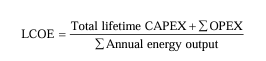
Economic evaluation frameworks: The economic viability of bifacial agrivoltaic systems is typically assessed using life-cycle cost analysis, with Levelized Cost of Energy (LCOE) as the primary metric. A LCOE is calculated as:
 |
(2) |
where, CAPEX represents the upfront capital expenditure, including equipment, installation, and commissioning costs; OPEX represents operational expenditures over the project lifetime, such as maintenance, insurance, and repairs; and Annual Energy Output is the electricity generated each year, summed across the system’s operational life20.
For agrivoltaic systems, economic evaluation must account for both energy revenue and agricultural income, requiring a more comprehensive approach that considers:
| • | Energy revenue: Electricity sales, avoided grid purchases, or value of self-consumption | |
| • | Agricultural revenue: Crop sales, avoided losses, or value of improved quality | |
| • | Cost savings: Reduced irrigation costs, avoided diesel generation, or reduced post-harvest losses | |
| • | Land value: Opportunity cost of land, avoided land acquisition costs, or land productivity gains |
|
Capital expenditure analysis: Capital expenditures for bifacial agrivoltaic systems in Nigeria consist of several components:
| • | Module costs: Bifacial modules typically command a 3-7% price premium over monofacial alternatives, reflecting more advanced cell architectures and dual-glass construction13. Global manufacturing expansion has reduced this premium significantly in recent years | |
| • | Mounting structures: The elevated mounting heights required for bifacial optimization (>2 meters) and agricultural machinery access necessitate stronger support structures, increasing material costs by an estimated 10-20% compared to standard ground-mount systems15 | |
| • | Balance of system: Including wiring, inverters, transformers, and grid connection, which may require adjustment for bifacial systems but generally show comparable costs to monofacial systems21 | |
| • | Land preparation: Site clearing, grading, and foundation work, which may be more extensive for bifacial systems with wider row spacing22 | |
| • | Installation labor: Bifacial glass-glass modules are heavier (30-32 kg) than monofacial alternatives (20-25 kg), requiring more careful handling and potentially increasing labour costs23 |
Cumulatively, the total installed CAPEX for an optimized bifacial agrivoltaic system is estimated at 5-15% higher than for a monofacial system of equivalent nameplate capacity13,21.
Energy yield and revenue analysis: Energy yield is the primary revenue driver for agrivoltaic systems, and bifacial modules offer significant advantages:
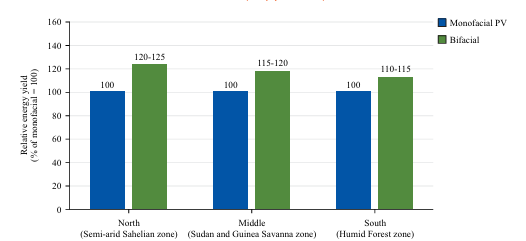
| • | Bifacial energy gains: Field evidence shows median bifacial energy gains of 14-20% over monofacial references, with agrivoltaic-specific installations often achieving higher gains due to elevated mounting and favorable ground conditions11. The relative energy yield advantage of bifacial photovoltaic systems across Nigeria’s major agroecological zones is illustrated in Fig. 3. Although the magnitude of the bifacial gain varies according to climatic conditions, bifacial systems consistently outperform monofacial modules across all zones, with the largest gains projected for the semi-arid Northern Region. Monofacial photovoltaic systems are normalized to a relative energy yield of 100%. Bifacial photovoltaic systems exhibit projected energy gains of approximately 20-25% in the semi-arid northern region, 15-20% in the Sudan and Guinea Savanna (Middle Belt), and 10-15% in the humid forest zone. These regional differences reflect variations in solar irradiance, ground albedo, and climatic conditions. Values are synthesized from the literature and adapted from Yakubu et al.11 and Adeh et al.24 | |
| • | Gain determinants: The actual bifacial gain depends on ground albedo, mounting geometry, climatic conditions, and module characteristics. For Nigerian conditions, projected gains range from 10-15% in Southern zones to 18-25% in Northern semi-arid Regions11,24 | |
| • | Revenue implications: The additional energy yield translates directly to higher revenue, with the extent depending on electricity tariffs, feed-in tariffs, or avoided grid costs. For Nigerian applications, where electricity costs are high and grid reliability is limited, the value of self-consumption may be particularly significant3 |
Agricultural benefits and cost savings: Beyond energy revenue, agrivoltaic systems generate agricultural benefits that contribute to economic viability:
| • | Irrigation water savings: Studies consistently report 10-30% reductions in irrigation demand under agrivoltaic systems due to reduced evaporative losses and moderated temperatures25. For Nigeria, where irrigation costs are significant and water is increasingly scarce, these savings have substantial economic value | |
| • | Yield maintenance or enhancement: For shade-tolerant crops, agrivoltaic systems may maintain or enhance yields compared to open-field production26. The improved light uniformity beneath bifacial arrays can reduce intra-plot variability and improve harvest quality27 | |
| • | Quality improvements: Reduced sunscald, lower temperatures, and moderated microclimate can improve crop quality, increasing market value26. This is particularly important for high-value horticultural crops | |
| • | Post-harvest loss reduction: Solar-powered cold storage can extend shelf life for perishable produce, reducing post-harvest losses that can exceed 30% in Nigeria1,2 | |
| • | Avoided diesel costs: In off-grid and weak-grid contexts, solar generation replaces expensive diesel for irrigation and other farm operations, generating significant savings28,29 |
Levelized cost of energy analysis: Synthesized evidence indicates that bifacial systems achieve lower LCOE than monofacial alternatives despite higher capital costs. Life-cycle cost assessments for ground-mounted installations with albedo exceeding 0.35 consistently demonstrate that bifacial PV systems attain LCOE reductions of 8-12% compared to monofacial systems16,20,30. This advantage extends to agrivoltaic applications, where the energy yield advantage offsets the 5-15% higher initial capital expenditure.
For medium- and large-scale installations in Nigeria, calculated LCOE values of approximately 10-11 ₦/kWh for vertical bifacial systems indicate financial viability, though actual figures vary depending on capital costs, system design, location, financing conditions, and long-term performance24. The value of LER becomes paramount in contexts of high land cost or scarcity, as a bifacial system with higher system LER generates more total economic output per hectare9.
Nigerian context and opportunities
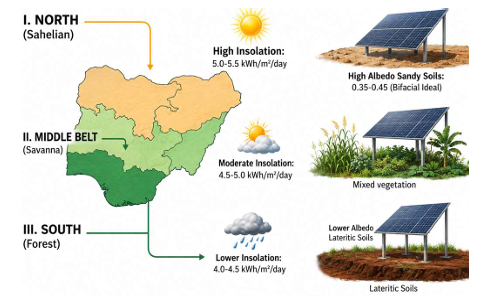
Agroecological diversity and economic potential: Nigeria’s diverse agroecological zones exhibit considerable spatial variation in their suitability for bifacial agrivoltaic (AV) systems, reflecting differences in solar resource availability, soil reflectance (albedo), climatic conditions, and dominant agricultural production systems. As illustrated in Fig. 4, the economic potential of bifacial agrivoltaics follows a pronounced north-south gradient. The semi-arid northern regions provide the most favourable conditions because of their high solar irradiance, highly reflective sandy soils, and increasing water scarcity, whereas the humid southern regions, despite lower photovoltaic performance, offer significant opportunities through improved crop quality, post-harvest preservation, and value addition.
The schematic illustrates the variation in solar irradiance, soil albedo, and vegetation characteristics across Nigeria’s major agroecological zones and their implications for bifacial agrivoltaic performance. The Northern Sahelian zone is characterised by high solar insolation (5.0-5.5 kWh/m2/day) and highly reflective sandy soils, creating favourable conditions for enhanced bifacial energy generation. The Middle Belt (Sudan and Guinea Savanna) exhibits moderate solar resources (4.5-5.0 kWh/m2/day) and mixed vegetation, providing intermediate performance. In contrast, the humid Southern forest zone receives lower solar irradiance (4.0-4.5 kWh/m2/day) and is dominated by low-albedo lateritic soils, resulting in comparatively lower energy yields but greater opportunities for high-value horticulture and post-harvest applications. The economic implications of these agroecological differences are discussed below.
|
Semi-arid Sahelian zone (Northern Nigeria): The Sahelian zone offers the highest economic potential for bifacial agrivoltaic deployment owing to its combination of high solar insolation (5.0-5.5 kWh/m2/day), highly reflective sandy soils (albedo: 0.35-0.45), and limited water availability. These conditions enhance rear-side irradiance, leading to projected bifacial energy gains of approximately 18-25% relative to monofacial systems. In addition, partial shading beneath PV modules reduces evapotranspiration, contributing to irrigation water savings of approximately 15-25%19,23. The integration of electricity generation with the cultivation of drought-tolerant crops such as sorghum, millet, and cowpea, alongside irrigated vegetable production, provides multiple revenue streams and strengthens overall project profitability.
Sudan and Guinea Savannah zones (Middle Belt): The Sudan and Guinea Savanna zones possess moderate solar irradiance (4.5-5.0 kWh/m2/day), seasonal vegetation cover, and diversified mixed-cropping systems, making them suitable for intermediate-scale bifacial agrivoltaic deployment. Projected bifacial energy gains of 15-20%, coupled with appreciable reductions in irrigation demand, indicate favourable economic viability across these regions19. The coexistence of staple crops such as maize and cassava with commercially important horticultural crops further enhances the economic attractiveness of integrated food-energy production systems.
Humid forest zone (Southern Nigeria): The humid forest zone is characterised by lower solar irradiance (4.0-4.5 kWh/m2/day), dense vegetation, and low-reflectance lateritic soils, factors that reduce the relative performance advantage of bifacial photovoltaic modules. Consequently, projected bifacial energy gains are more modest, typically ranging between 10% and 15%. Nevertheless, the region offers substantial economic opportunities through the cultivation of high-value horticultural crops. Agrivoltaic systems can improve crop quality by mitigating heat stress and sunscald, while solar-powered cold storage can reduce post-harvest losses and enhance market value, particularly for export-oriented horticultural supply chains3,30. These complementary benefits can offset lower electricity generation and improve the overall economic feasibility of agrivoltaic investments in Southern Nigeria.
|
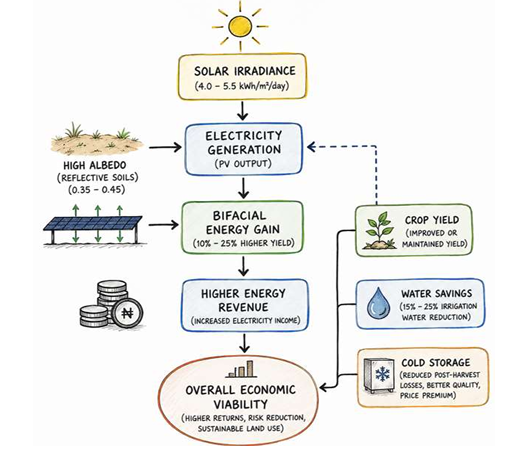
While the magnitude of economic benefits varies across Nigeria’s agroecological zones, the profitability of bifacial agrivoltaic systems is ultimately governed by the interaction of both energy- and agriculture-related factors. These interrelationships are summarized in Fig. 5, which presents a conceptual framework linking the primary technical and agricultural drivers to overall economic viability.
Solar irradiance and soil albedo enhance electricity generation and bifacial energy gains, leading to higher energy revenue. Complementary agricultural benefits; including improved crop yield, irrigation water savings, and solar-powered cold storage, further contribute to overall economic viability by increasing farm productivity, reducing production costs, and diversifying income streams.
Figure 5 demonstrates that the economic viability of bifacial agrivoltaic systems extends beyond enhanced electricity generation. While increased solar energy production remains the principal source of additional revenue, agricultural co-benefits; including improved crop productivity, reduced irrigation requirements, and post-harvest value addition through solar-powered cold storage, substantially improve the overall financial performance of integrated food-energy systems. Consequently, the relative contribution of each driver varies across Nigeria’s agroecological zones, with energy gains dominating in the northern Sahelian regions and agricultural value addition becoming increasingly important in the humid Southern zones.
Crop-specific economic analysis: Different crop types present varying economic returns under agrivoltaic systems:
| • | High-value horticulture: Vegetables, herbs, and fruits that benefit from shade and quality improvements offer the strongest economic case. In Nigerian conditions, amaranth, peppers, and tomatoes have demonstrated adaptability to agrivoltaic systems with significant irrigation savings3,30 |
|
| • | Staple crops: Maize, sorghum, and cassava have more complex shade responses. Strategic configuration with wider alleys and moderate shading (20-30%) can maintain productivity while generating energy revenue31. The economic case depends on relative energy and crop values | |
| • | Commodity crops: Oil palm, cocoa, and other tree crops present opportunities for higher-mounted bifacial arrays in agroforestry-style configurations. Long-term investments align with bifacial module warranties13 | |
| • | Livestock integration: Poultry and livestock shading offers thermal stress reduction benefits that improve productivity and reduce mortality. Combined with solar-powered ventilation and feed processing, these systems generate multiple revenue streams4 |
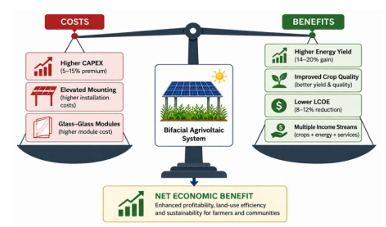
Financing and investment considerations: The economic viability of bifacial agrivoltaic systems depends critically on access to appropriate financing and on balancing higher upfront investment costs against long-term economic returns. Although bifacial systems require greater initial capital expenditure than conventional monofacial systems, their enhanced electricity generation, improved agricultural productivity, and diversified income streams can substantially improve project profitability over the system lifetime (Fig. 6).
The schematic illustrates the economic trade-offs associated with bifacial agrivoltaic deployment. While higher capital investment is required for glass-glass modules and elevated mounting structures, these additional costs are compensated by increased energy yield, improved crop quality, lower LCOE, and multiple income streams, resulting in a favourable net economic benefit over the project lifetime.
Capital requirements: The 5-15% higher CAPEX for bifacial systems presents a barrier in Nigeria’s capital-constrained agricultural sector. Blended finance mechanisms, government subsidies, or development finance can address this gap3.
Revenue streams: Diversified revenue from electricity generation, crop production, quality premiums, and other agrivoltaic co-benefits enhances financial resilience and reduces investment risk. Recognition of the higher energy output of bifacial systems through favourable Power Purchase Agreements can further improve project bankability21,32.
Payback periods: Life-cycle analysis suggests that the additional energy yield of bifacial systems can offset higher upfront costs over 5-7 years, after which the systems generate superior returns13,33. Long-term performance warranties (30 years) align with agricultural investment horizons13.
Risk factors: Performance uncertainty (±5-8%), technology reliability concerns, and policy instability are risk factors that affect investment decisions. Mitigation strategies include insurance mechanisms, performance guarantees, and policy frameworks that provide long-term certainty34.
IMPLEMENTATION PATHWAYS AND POLICY RECOMMENDATIONS
Demonstration and scaling: Strategic implementation of bifacial agrivoltaics in Nigeria requires a phased approach:
Phase 1: Demonstration sites: Establish 5-10 demonstration sites across Nigeria’s diverse agroecological zones, with comprehensive monitoring of energy generation, crop yield, and economic performance. These sites should serve as learning platforms and public education tools3,30.
Phase 2: Technology adaptation: Refine system designs for Nigerian conditions based on demonstration results. Develop locally appropriate mounting structures, crop selection guidelines, and management practices15.
Phase 3: Commercial scaling: Leverage demonstration results to attract commercial investment. Develop financing mechanisms, supply chains, and technical capacity to support widespread deployment1-2.
Phase 4: Mainstream integration: Integrate agrivoltaic considerations into agricultural development plans, energy strategies, and land-use planning. Develop institutional frameworks that support sustained deployment3.
Policy interventions: Several policy interventions can accelerate bifacial agrivoltaic deployment:
Agricultural policy integration: Mainstream agrivoltaics into agricultural extension services, irrigation programs, and rural development initiatives. Recognize agrivoltaic systems as eligible for agricultural investment incentives1-2.
Energy policy alignment: Include agrivoltaic systems in renewable energy targets and incentives. Develop power purchase agreement structures that recognize bifacial yield advantages21,32.
Land-use planning: Integrate dual-use metrics into land-use planning frameworks. Recognize agrivoltaics as a land-use category with specific zoning and permitting requirements8,35.
Financing mechanisms: Establish blended finance facilities that address the capital cost premium of bifacial systems. Develop credit guarantees, first-loss provisions, or interest subsidies to improve investment viability36.
Technical standards: Develop national technical standards for agrivoltaic installations, addressing system design, safety, and performance requirements. Support certification programs to ensure quality13,33.
Capacity building: Invest in technical education and training programs for engineers, agronomists, and technicians. Support university curricula and research programs in agrivoltaics23.
Institutional frameworks: Effective implementation requires coordination across multiple institutions:
Inter-ministerial coordination: Establish mechanisms for coordination between agricultural, energy, environment, and planning ministries at federal and state levels2.
Public-private partnerships: Leverage private sector investment and expertise through structured partnerships. Develop build-operate-transfer models, concession agreements, or joint ventures3.
Research-extension linkages: Strengthen connections between research institutions, universities, and agricultural extension services. Ensure that research findings inform practice and policy23.
Community engagement: Involve local communities in project planning and implementation. Ensure that agrivoltaic benefits are equitably distributed and aligned with community needs14.
CHALLENGES AND RISK MITIGATION
Technical challenges: Technical challenges include performance prediction uncertainty (±5-8%), limited long-term durability data, and adaptation to Nigerian climatic conditions34. Mitigation strategies include comprehensive monitoring programs, accelerated testing protocols, and adaptive management approaches that refine designs based on empirical evidence37,38.
Economic challenges: Economic challenges include higher capital costs (5-15%), financing barriers in capital-constrained contexts, and uncertain revenue streams20,21. Mitigation strategies include blended finance, output-based incentives, and risk-sharing mechanisms that address these barriers3.
Institutional challenges: Institutional challenges include policy gaps, limited technical capacity, and coordination failures across government ministries and agencies1-2. Mitigation strategies include policy reform, capacity building programs, and institutional coordination mechanisms.
Market challenges: Market challenges include limited awareness and understanding of agrivoltaic technology, underdeveloped supply chains, and uncertain market structures3-4. Mitigation strategies include market development programs, public awareness campaigns, and demonstration projects that build confidence.
RECOMMENDATION
From the findings of this study, the following recommendations are made:
| • | Establishment of demonstration networks across Nigeria’s agroecological zones to generate empirical evidence on land-use efficiency and economic performance. These should include comprehensive monitoring of energy generation, crop yield, and economic outcomes | |
| • | Development of context-specific economic models for bifacial agrivoltaic systems in different Nigerian settings. These should account for local conditions, crop choices, market prices, and policy environments to inform investment decisions | |
| • | Integration of land-use efficiency metrics into agricultural and energy planning frameworks. Recognize agrivoltaics as a dual-use land category with specific planning, permitting, and incentive considerations | |
| • | Establishment of blended finance mechanisms that address the capital cost premium of bifacial systems. Include credit guarantees, first-loss provisions, or interest subsidies to improve investment viability | |
| • | Development of production-based incentives that reward the higher energy yield of bifacial systems. Structure Power Purchase Agreements and feed-in tariffs to recognize bifacial gain | |
| • | Building of technical and institutional capacity for agrivoltaic system design, installation, and operation. Invest in education, training, and extension programs | |
| • | Support to local manufacturing and assembly of agrivoltaic components to reduce costs and create employment. Encourage technology transfer and adaptation | |
| • | Establishment of long-term reliability studies to reduce performance uncertainty and improve financial viability. Monitor system performance, degradation rates, and operational costs over extended periods | |
| • | Integration of agrivoltaics into climate-smart agriculture programs, recognizing the technology’s potential for adaptation and mitigation. Include agrivoltaics in carbon credit schemes | |
| • | Promotion of knowledge sharing through farmer demonstration events, extension programs, and digital platforms. Build on existing Nigerian solar and agricultural initiatives to accelerate adoption |
CONCLUSION
The systematic review demonstrates that bifacial agrivoltaic systems provide enhanced land-use efficiency and economic performance compared with monofacial alternatives. Bifacial systems achieve Land Equivalent Ratios of 1.56-1.93 versus 1.27-1.50 for monofacial systems, representing a 20-30% improvement in combined land productivity. Although bifacial modules incur a 5-15% higher initial cost, 14-20% greater energy yields reduce the levelized cost of electricity by 8-12%. Nigeria’s semi-arid northern regions offer the highest projected gains (18-25%) due to high-albedo soils, while the Middle Belt and humid Southern regions achieve gains of 15-20% and 10-15%, respectively. Additional benefits include 15-25% irrigation water savings, improved crop quality, reduced post-harvest losses, and diversified revenue streams through lower diesel dependence and potential carbon credits. However, successful deployment requires addressing key challenges, including higher capital investment, limited field data, performance uncertainty, and policy gaps, which require careful planning and oversight. Stakeholders should therefore adopt targeted policies, pilot-scale demonstrations, innovative financing mechanisms, and locally adapted system designs to ensure responsible implementation. Future studies should evaluate the practical effects of bifacial agrivoltaics on crop-specific yield responses, long-term system durability, soil health, farmer livelihoods, and food-energy-water nexus outcomes under real Nigerian conditions.
SIGNIFICANCE STATEMENT
This review provides a timely synthesis of the land-use efficiency, economic viability, and implementation pathways of bifacial agrivoltaic systems in Nigeria. It is significant because it highlights both the technical benefits and economic limitations of bifacial technology while emphasizing the importance of agroecological adaptation, context-specific design, and policy support in agricultural and energy contexts. The manuscript also contributes practical guidance for responsible agrivoltaic deployment and identifies key areas for future research, including crop-specific yield responses, long-term system performance, soil health impacts, farmer livelihoods, and food-energy-water nexus outcomes in Nigerian environments.
ACKNOWLEDGMENT
The authors sincerely acknowledge the extensive body of scholarship that informed this comprehensive review and contributed to a deeper understanding of bifacial agrivoltaic systems in Nigeria. We also express appreciation to the researchers whose published works provided the foundation for the analysis and discussion presented in this manuscript.
REFERENCES
- Mamah, I.M., I. Kiani and U.K. Atata, 2025. Maximizing solar energy potential in Nigeria: A physics and computational approach to overcoming challenges. Int. J. Innovative Math. Stat. Energy Policies, 13: 66-71.
- Onuh, P., J.O. Ejiga, E.O. Abah, J.O. Onuh, C. Idogho and J. Omale, 2024. Challenges and opportunities in Nigeria's renewable energy policy and legislation. World J. Adv. Res. Rev., 23: 2354-2372.
- Abubakar, S.I., C.H. See, F.M. Sukki, R. Mahendiran, S. Sundaram, M.I. Zainal Abidin and M.K.A. Kamarudin, 2025. Deploying agrivoltaics in Sub-Saharan Africa-a sustainable pathway toward energy-food security-challenges and opportunities: A review. IEEE Access, 13: 87810-87833.
- Anyene, C.C., D.O. Udorah, P.S. Nsofor and N.R. Nwakuba, 2025. Prospects of agrivoltaics as a sustainable mitigation solution to the nomadic cattle rearing crisis in Nigeria: A review. Agric. Sci. Food Process., 2: 148-172.
- Ndukwu, M.C., D.I. Onwude, L. Bennamoun, F.I. Abam, M. Simo-Tagne, I.T. Horsfall and T.A. Briggs, 2021. Nigerias energy deficit: The challenges and eco-friendly approach in reducing the energy gap. Int. J. Sustainable Eng., 14: 442-459.
- Maity, R., N.P. Hariram, M.M. Quazi and S. Kumarasamy, 2025. Agrivoltaic systems for sustainability: An overview of emerging trends and practices. Sol. Compass, 16.
- Pandey, G., S. Lyden, E. Franklin, B. Millar and M.T. Harrison, 2025. A systematic review of agrivoltaics: Productivity, profitability, and environmental co-benefits. Sustainable Prod. Consumption, 56: 13-36.
- Toledo, C. and A. Scognamiglio, 2021. Agrivoltaic systems design and assessment: A critical review, and a descriptive model towards a sustainable landscape vision (three-dimensional agrivoltaic patterns). Sustainability, 13.
- Arena, R., S. Aneli, A. Gagliano and G.M. Tina, 2024. Optimal photovoltaic array layout of agrivoltaic systems based on vertical bifacial photovoltaic modules. Sol. RRL, 8.
- Padilla, J., C. Toledo and J. Abad, 2022. Enovoltaics: Symbiotic integration of photovoltaics in vineyards. Front. Energy Res., 10.
- Yakubu, R.O., L.D. Mensah, D.A. Quansah and M.S. Adaramola, 2024. A systematic literature review of the bifacial photovoltaic module and its applications. J. Eng., 2024.
- Jamil, U., M.M. Rahman and J.M. Pearce, 2025. Photosynthetically active radiation complexities in agrivoltaic policy mandates: Insights from controlled environment yields under semitransparent photovoltaics. J. Cleaner Prod., 523.
- Demir, H., A.E. Coşgun, M.S. Endiz and B. Şenol, 2026. Maximizing energy generation in agrivoltaic systems: A study of bifacial and monofacial modules with consideration of module height and albedo impact. Energy Sci. Eng., 14: 1795-1807.
- Randle-Boggis, R.J., G.A. Barron-Gafford, A.A. Kimaro, C. Lamanna and C. Macharia et al., 2025. Harvesting the sun twice: Energy, food and water benefits from agrivoltaics in East Africa. Renewable Sustainable Energy Rev., 208.
- Bellone, Y., E. Santangelo, A. Assirelli, S. Zainali and G. Impollonia et al., 2026. Agricultural mechanization in agrivoltaic systems: Challenges, adaptation, and possible advancements. Renewable Sustainable Energy Rev., 229.
- Ayadi, O., R. Shadid, M.A. Hamdan, Q. Aburumman and A.B. Abdullah et al., 2026. Comparative experimental performance assessment of tilted and vertical bifacial photovoltaic configurations for agrivoltaic applications. Sustainability, 18.
- Ferry, A., M. Parenti, M. Thebault, C. Ménézo and M. Fossa, 2025. Optimal tilt angles for bifacial photovoltaic plants across Europe based on cumulative sky and Typical Meteorological Year data. Sol. Energy, 293.
- Alam, M., M.S. Gul and T. Muneer, 2023. Performance analysis and comparison between bifacial and monofacial solar photovoltaic at various ground albedo conditions. Renewable Energy Focus, 44: 295-316.
- Gul, M.S., M. Alam and T. Muneer, 2025. Feasibility of bifacial photovoltaics in transport infrastructure. Energies, 18.
- Santhakumar, S., H. Meerman and A. Faaij, 2024. Future costs of key emerging offshore renewable energy technologies. Renewable Energy, 222.
- Kamble, S.M., 2025. Comparative study of bifacial vs. monofacial solar cells: A comprehensive efficiency and cost-benefit analysis for temperate climates. Int. J. Eng. Res. Sustainable Dev., 1: 38-40.
- Zidane, T.E.K., S. Zainali, Y. Bellone, M. Guezgouz and A. Khosravi et al., 2025. Economic evaluation of one-axis, vertical, and elevated agrivoltaic systems across Europe: A Monte Carlo analysis. Appl. Energy, 391.
- Noh, Y. and J. Lee, 2024. Building-integrated photovoltaic applied Bi-facial photovoltaic module structural design. Sol. Energy Mater. Sol. Cells, 269.
- Adeh, E.H., J.S. Selker and C.W. Higgins, 2018. Remarkable agrivoltaic influence on soil moisture, micrometeorology and water-use efficiency. PLoS ONE, 13.
- Kolega, Š., A. Zdrilić, T. Kos, M. Zorica, V. Zebec, J. Ravlić and M. Lisjak, 2026. Agrivoltaics revisited: Critical insights into shading-induced microclimate change, yield and quality, biodiversity shifts and socio-economic limitations. AgriEngineering, 8.
- Asa'a, S.N., S.M. Lu, I. Kaaya, O. Dupon and R. de Jong et al., 2025. Evaluating the influence of different agrivoltaic topologies on PV energy, crop yields and land productivity in a temperate climate. Renewable Energy, 252..
- Agbo, E.P., C.O. Edet, T.O. Magu, A.O. Njok, C.M. Ekpo and H. Louis, 2021. Solar energy: A panacea for the electricity generation crisis in Nigeria. Heliyon, 7.
- Olabi, A.G., K. Elsaid, K. Obaideen, M.A. Abdelkareem and H. Rezk et al., 2023. Renewable energy systems: Comparisons, challenges and barriers, sustainability indicators, and the contribution to UN sustainable development goals. Int. J. Thermofluids, 20.
- Zhang, C., H. Shen and H. Liu, 2023. The influence of the installation condition and performance of bifacial solar modules on energy yield. Energies, 16.
- Favi, S.G., A. Rabani, T. Godjo, M. Trommsdorff and N.C. Giri, 2023. Agrivoltaic system: Current and future water, energy, food, and land (WEFL) needs in Benin, West Africa. AgriVoltaics Conf. Proc., 2.
- Yang, Y., G. Liu, X. Guo, W. Liu and J. Xue et al., 2022. Effect mechanism of solar radiation on maize yield formation. Agriculture, 12.
- Abdulkadir, F., S. Sarr, G. Stratton and S. Upadhaya, 2026. Techno-economic viability of agrivoltaics for small-scale farmers under policy and market uncertainty. Cleaner Energy Syst., 14.
- Lim, B.H., H.L. Tan, M.H. Tan, L. Qi and Y. Zhang et al., 2026. Long-term field evaluation of bifacial photovoltaic systems at a tropical site: Characteristics of bifacial gain, electricity yield, degradation, and techno-economic assessment. Energy Rep., 16.
- Merodio, P., F. Martínez-Moreno, R. Moretón and E. Lorenzo, 2023. Albedo measurements and energy yield estimation uncertainty for bifacial photovoltaic systems. Prog. Photovoltaics Res. Appl., 31: 1130-1143.
- Mouhib, E., L. Micheli, F. Almonacid and E. Fernández, 2022. Overview of the fundamentals and applications of bifacial photovoltaic technology: Agrivoltaics and aquavoltaics. Energies, 15.
- Badrudeen, T.U., N. Nwulu, B.O. Olorunfemi and O. Esan, 2025. Optimization and cost evaluation of hybrid solar-wind-diesel-battery model for agri-food production in South Africa. Results Eng., 28.
- Kim, J., M. Rabelo, S.P. Padi, H. Yousuf, E.C. Cho and J. Yi, 2021. A review of the degradation of photovoltaic modules for life expectancy. Energies, 14.
- Hsi, P.H. and J.C.P. Shieh, 2024. How credible is the 25-year photovoltaic (PV) performance warranty?-A techno-financial evaluation and implications for the sustainable development of the PV industry. Sustainability, 16.
How to Cite this paper?
APA-7 Style
Christian, A. C. C., Anyene, O. B., & Juliana, O. N. (2026). Beyond conventional agrivoltaics: Agroecological and economic pathways for bifacial solar-agriculture integration in nigeria. Trends in Social Sciences, 2(1), 69–84. https://doi.org/10.21124/tss.2026.69.84
ACS Style
Christian, A. C. C.; Anyene, O. B.; Juliana, O. N. Beyond Conventional Agrivoltaics: Agroecological and Economic Pathways for Bifacial Solar-Agriculture Integration in Nigeria. Trends Social Sci 2026, 2 (1), 69–84. https://doi.org/10.21124/tss.2026.69.84
AMA Style
Christian ACC, Anyene OB, Juliana ON. Beyond conventional agrivoltaics: agroecological and economic pathways for bifacial solar-agriculture integration in nigeria. Trends in Social Sciences. 2026;2(1):69–84. doi:10.21124/tss.2026.69.84
Chicago/Turabian Style
Christian, Anyene Chinedu Chukwuemeka, Ogochukwu Blessing Anyene, and Ogbuagu Nneka Juliana. 2026. “Beyond Conventional Agrivoltaics: Agroecological and Economic Pathways for Bifacial Solar-Agriculture Integration in Nigeria.” Trends in Social Sciences 2 (1): 69–84. https://doi.org/10.21124/tss.2026.69.84

This work is licensed under a Creative Commons Attribution 4.0 International License.